The Labyrinth of El Greco

from Byzantine icons to European Expressionism

Explore the exhibition
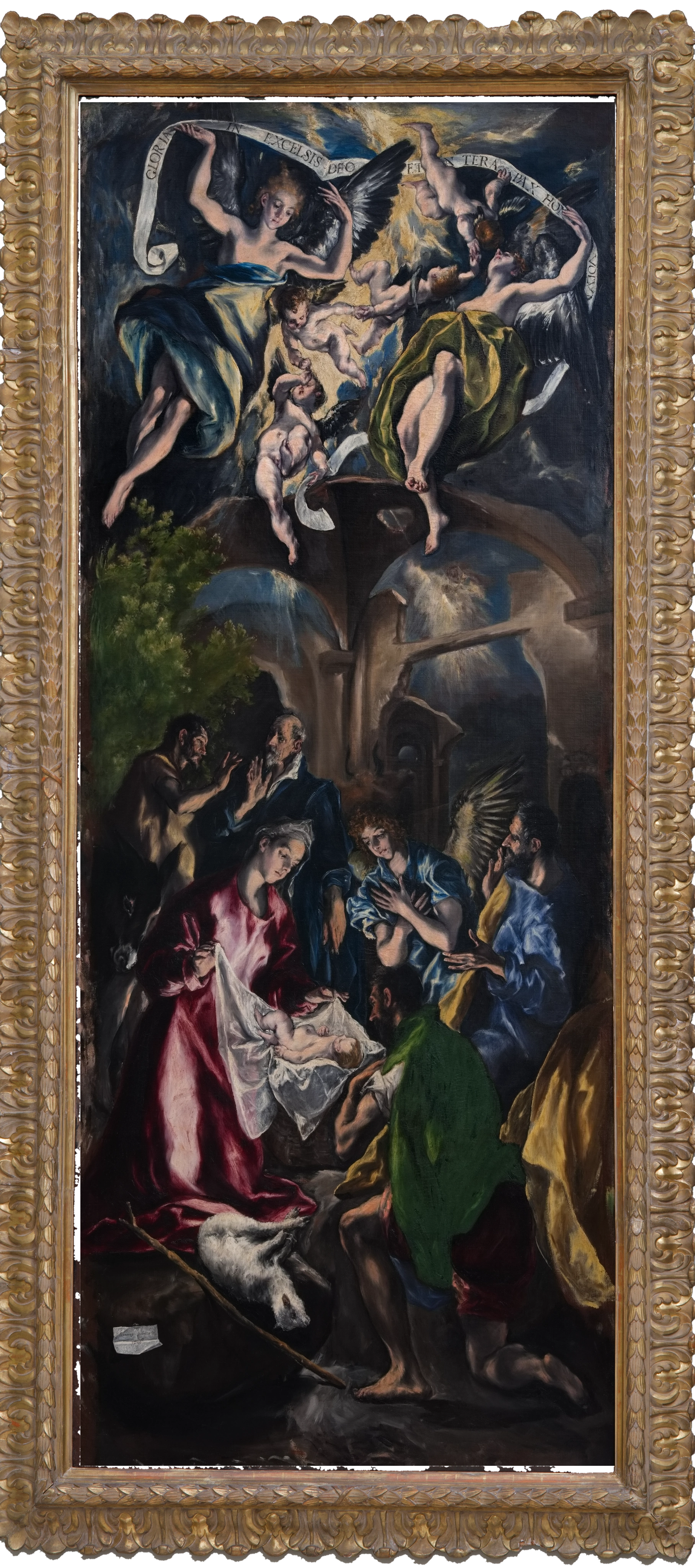
Detail from The Adoration of the Shepherds — Doménikos Theotokópoulos

Detail from The Adoration of the Shepherds, 1596–1600. MNAR.

View the complete artwork

About the exhibition

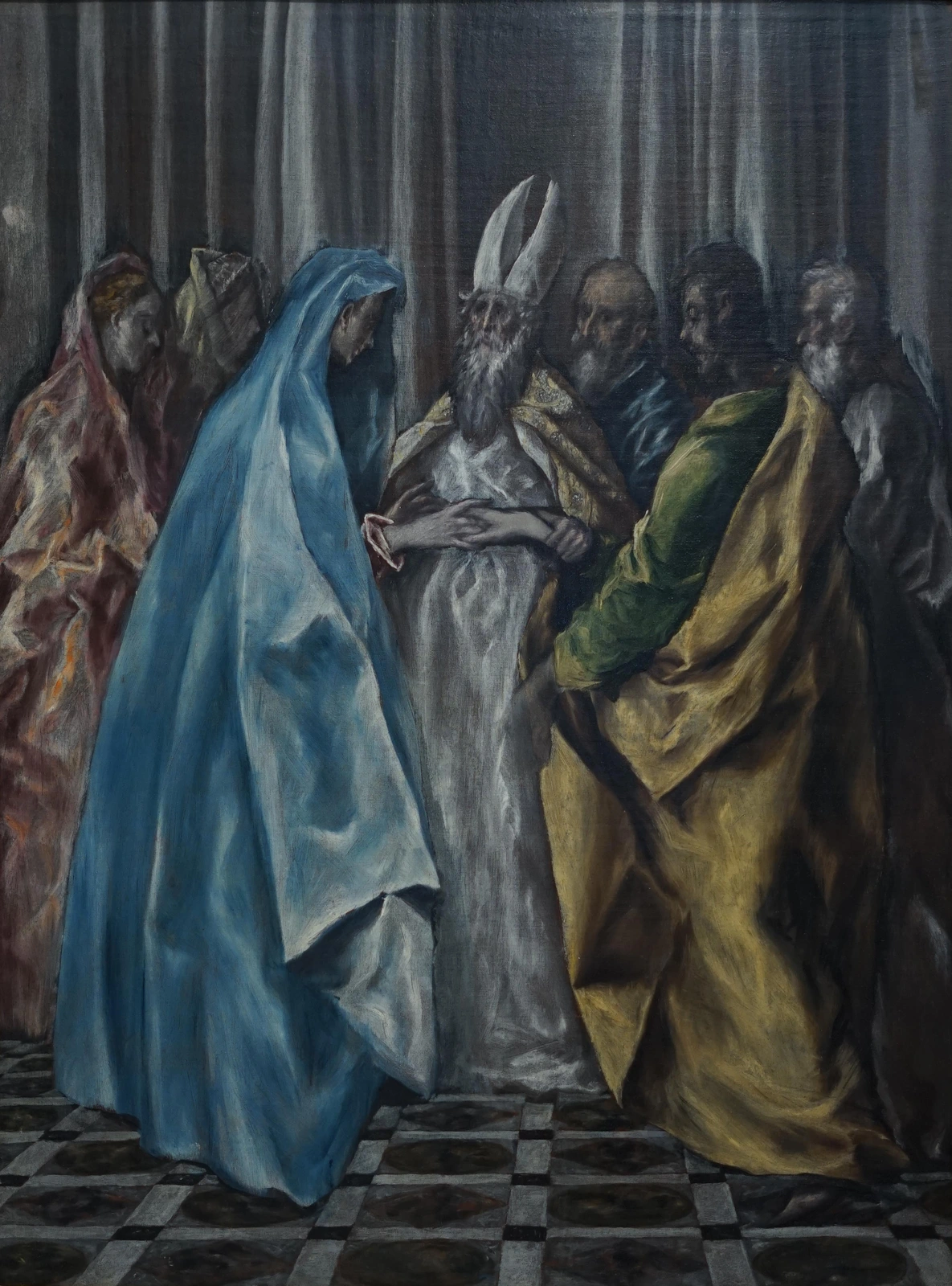
Born in Crete, trained in the tradition of icon painting and transformed by his encounter with the Italian Renaissance, Doménikos Theotokópoulos finds in Toledo the voice we now know as El Greco. His journey is not merely a passage between countries, but a continual reinvention of the image: colour becomes intensity, light creates space, and elongated bodies give form to a spiritual world. The exhibition follows this path, from the Byzantine legacy and his experiences in Venice and Rome to the modern and contemporary echoes of his work. Paintings by the artist meet those of his predecessors and those who rediscovered him. At the heart of the journey, The Adoration of the Shepherds and The Marriage of the Virgin invite us to look closely, attending to gesture, detail and the relationships between figures.

Crete

A painter’s formation in the Byzantine icon tradition.

Doménikos Theotokópoulos is born

In 1541, on Crete, the island to which Zeus, disguised as a bull, had carried Europa, Doménikos Theotokópoulos is born: “Menegos” in the local dialect. He grows up in a hybrid, bilingual culture at its height: Byzantine architecture with classical details, Latin and Greek schools, icons of Byzantine saints beneath Gothic arches. His life will come to resemble the labyrinth of Daedalus.

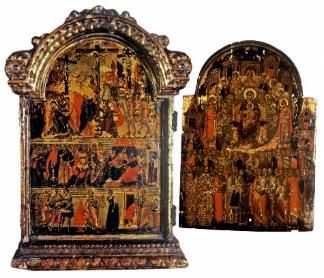
Triptych (two panels)

Cretan workshop

16th century · tempera on wood, 48.5 × 28 cm

National Museum of Art of Romania
Look closer

Cretan icons reach the Romanian lands

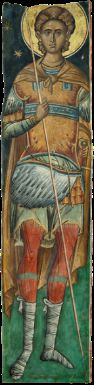
Cretan icons circulate widely throughout the Balkans and the Romanian principalities, becoming models for local workshops, especially the Virgin “Hodegetria”. Cretan craftsmen work on the frescoes of Argeș Monastery and, possibly, in Moldavia. Local art adopts their elegant lines, refinement, taste for miniatures and narrative, as well as saints dear to Cretans: Phanourios and the winged John the Baptist.

Saint Phanourios (?)

Cretan workshop

16th century · fresco, 242 × 58 cm

National Museum of Art of Romania
Look closer

“Maistro sgourafos”

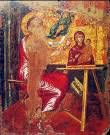
A document dated 6 June 1566 calls him “maistro sgourafos”: a formally recognised master painter. And a very well-paid one: a December receipt records 70 gold ducats for an icon of Christ, as much as a Tintoretto on the Venetian market. The few surviving icons from his Cretan years already introduce “quotations” from Raphael, Parmigianino and Zuccari, borrowed from engravings, into the Byzantine canon.

Saint Luke Painting the Virgin and Child

Doménikos Theotokópoulos

1560–67 · tempera on wood, 41.6 × 33 cm

Benaki Museum, Athens

Look closer

Venice and Rome

Encounters with Venetian painting and the artists of Rome.

A Cretan in the Serenissima

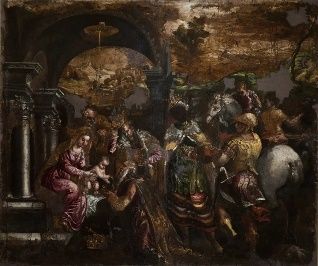
Aged 25, in the first months of 1567, he leaves Crete for good. Venice has 150,000 inhabitants, ten times as many as the colony, and is Europe’s most cosmopolitan metropolis. Many Greek icon painters here copy the Venetian masters using the techniques of icon painting. El Greco does not even appear in the Greek community’s registers. He wants to learn a different way of painting.

The Adoration of the Magi

Doménikos Theotokópoulos

1565–67 · oil on canvas, 148 × 173.5 cm

Accademia Nazionale di San Luca, Rome

Look closer

Titian, the patriarch

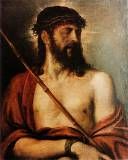
The supreme authority in Venetian painting is Titian, almost eighty, a count palatine since 1533 and Philip II’s favourite painter. He runs his workshop as a family business, with his brother, son and nephew. No document places El Greco there, but the Cretan studies his paintings, adopts his handling of paint and will describe himself throughout his life as a “disciple of Titian”.

Ecce Homo

Tiziano Vecellio (1490–1576)

c. 1560 · oil on canvas, 65.5 × 53 cm

Brukenthal National Museum, Sibiu

Look closer

“A young man from Candia…”

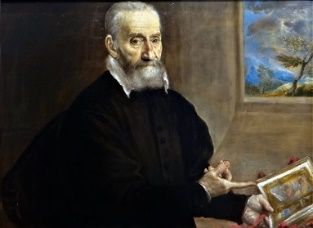
The first Roman trace is a letter of 16 November 1570. The miniaturist Giulio Clovio, aged 72, writes to Cardinal Alessandro Farnese: “A young man from Candia, a disciple of Titian, has arrived in Rome […] he has painted a self-portrait that has astonished all the painters in Rome.” He asks for a room for him in the Palazzo Farnese. El Greco paints Clovio holding his famous breviary.

Portrait of Giulio Clovio

Doménikos Theotokópoulos

1571 · oil on canvas, 58 × 86 cm

Museo Nazionale di Capodimonte, Naples

Look closer

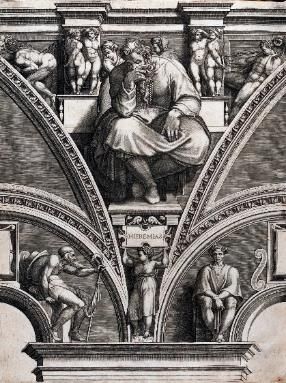
Repaint the Last Judgement?

His stay at the Palazzo Farnese ends abruptly in 1572, following an offence to the cardinal or an intrigue. Half a century later, the papal physician Giulio Mancini circulates an anecdote: El Greco supposedly offered to strip Michelangelo’s “Last Judgement” from the Sistine Chapel and paint a better one himself. It is unconfirmed, but plausible: Venetians and Tuscans were no great admirers of one another.

The Prophet Jeremiah (after Michelangelo)

Giorgio Ghisi (1520–1582)

engraving, 56.3 × 43.2 cm

National Museum of Art of Romania
Look closer

Toledo

Major commissions and the emergence of a distinctive language.

First commissions, first lawsuit

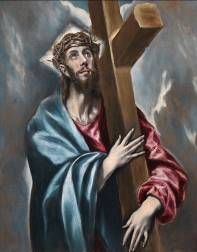
Soon after arriving in Toledo, he receives two major commissions through the cathedral’s dean, Diego de Castilla: the altarpieces for Santo Domingo el Antiguo, where he replaces the tiered Spanish altarpiece with a painting over four metres high, and “El Espolio” for the cathedral sacristy. The latter leads to his first lawsuit: he refuses to alter the painting. Such resolve is rare among the generally more compliant Spanish painters.

Christ Carrying the Cross

Doménikos Theotokópoulos

1600–05 · oil on canvas, 108 × 78 cm

Museo Nacional del Prado, Madrid

Look closer

The king says no

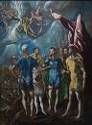
In 1579, Philip II sees the painting in Toledo Cathedral and commissions “The Martyrdom of Saint Maurice” for El Escorial, a canvas almost 4.5 metres high. El Greco works on it for three years, hoping to become a court painter. The king rejects it: the martyrdom is relegated to the background, almost a detail, while the Counter-Reformation demanded clear messages. Nevertheless, he pays 800 ducats and keeps the painting at the Escorial.

The Martyrdom of the Theban Legion

Jorge Manuel Theotocópuli (1578–1631)

1614–20 · oil on canvas, 145 × 107 cm

National Museum of Art of Romania
Look closer

Notes in the margins of Vasari

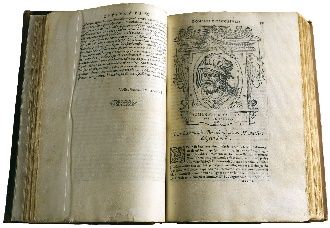
Federico Zuccari, an old friend from his Roman years, comes to work at the Escorial and visits him in Toledo. He gives him Giorgio Vasari’s celebrated “Lives” of the Italian artists, already annotated by Zuccari. El Greco fills the margins with his own, sometimes scathing, comments. He is an unusual intellectual among local painters: his library contains around 130 books in Greek, Italian and Spanish.

Le Vite […]

Giorgio Vasari (1511–1574)

1568 · printed book

“G. Oprescu” Institute of Art History

Look closer

The greatest altarpiece

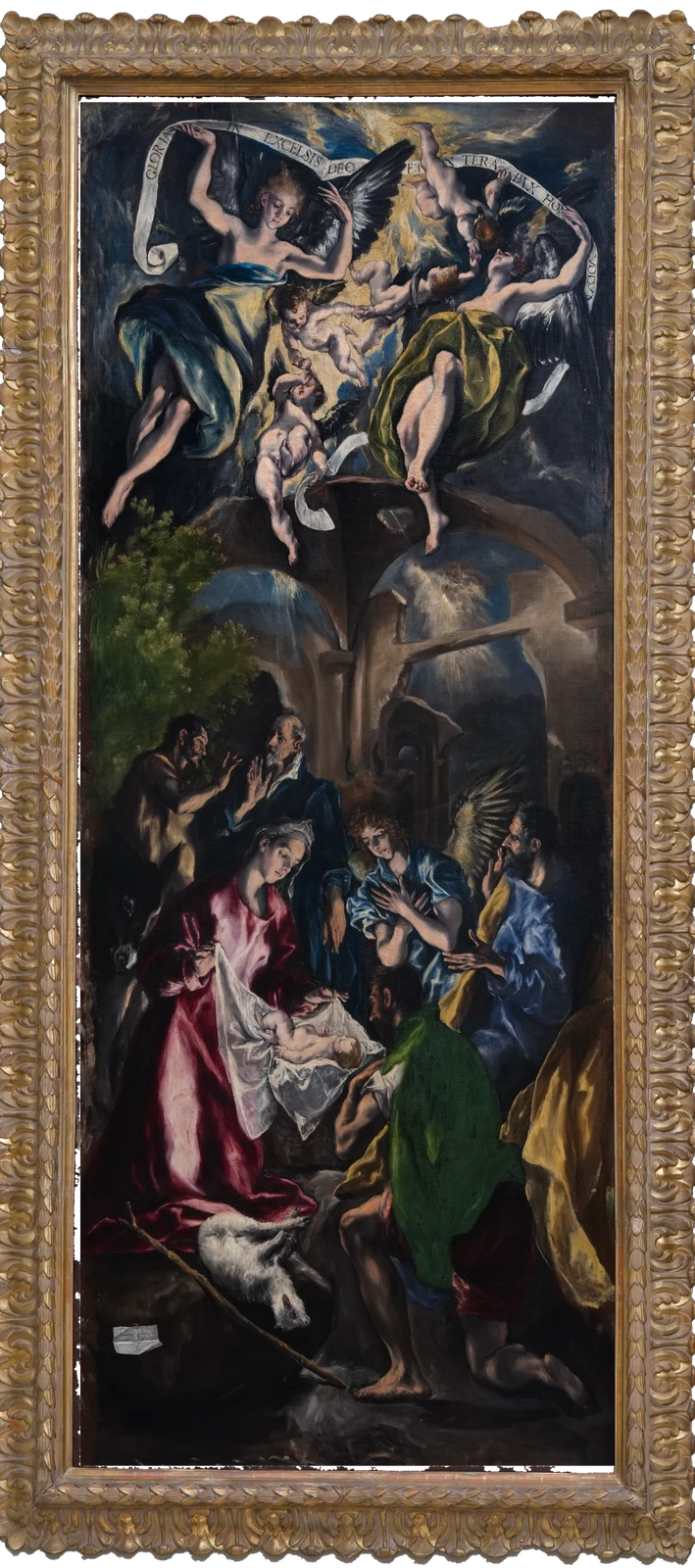
In July 1600, the grandest altarpiece of his career is installed in Madrid, in the church of the College of the Incarnation founded by Doña María de Aragón: over ten metres high, with seven paintings and statues of saints. The altarpiece is destroyed in the early nineteenth century; today, the Spanish Senate stands on the site of the church. The paintings are saved: five are at the Prado, while “The Adoration of the Shepherds” has reached Bucharest.

The Adoration of the Shepherds

Doménikos Theotokópoulos

1596–1600 · oil on canvas, 346 × 137 cm

National Museum of Art of Romania
Interactive exploration

The Adoration of the Shepherds

The Adoration of the Shepherds

A gesture that brings them together

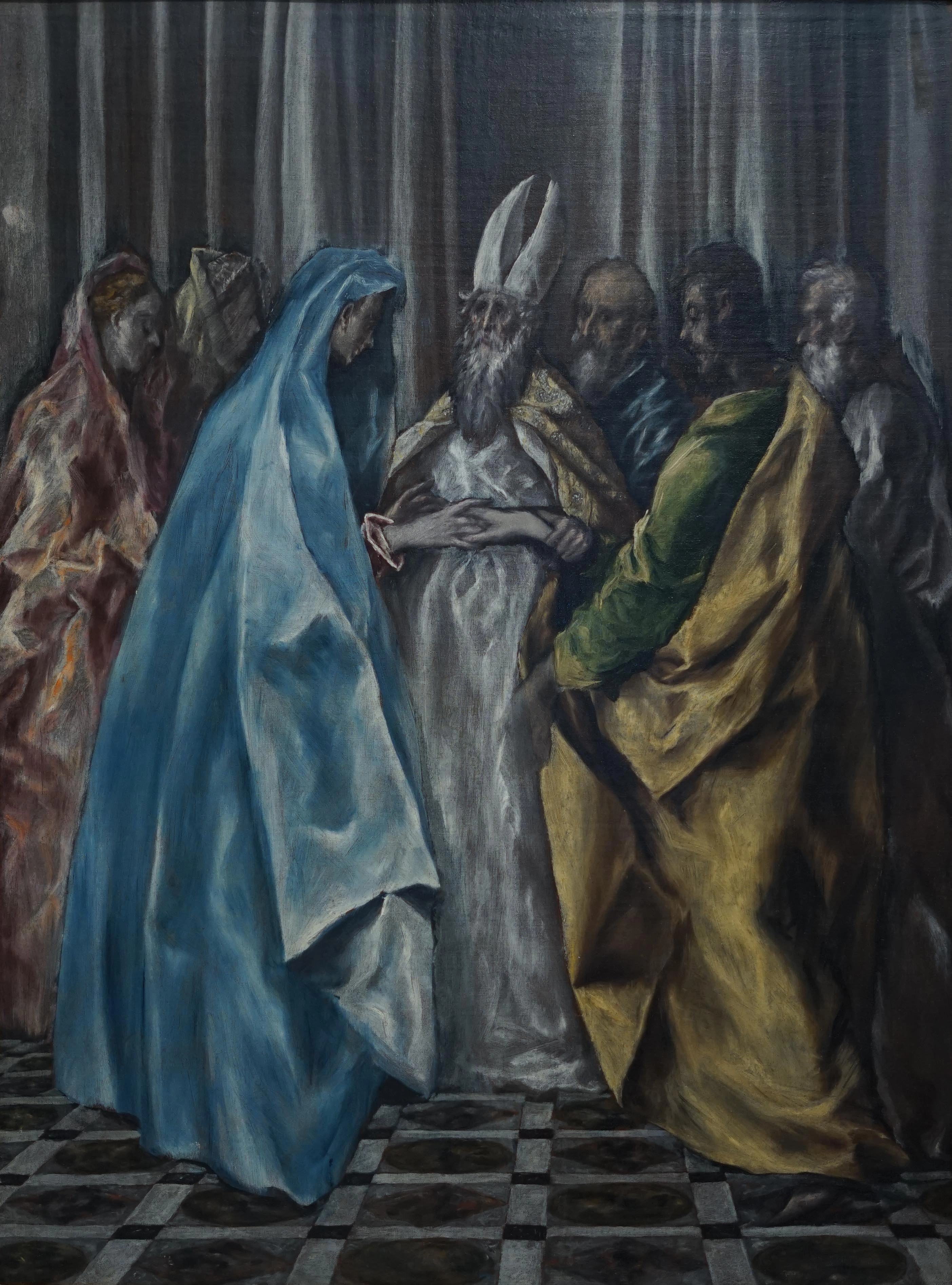
Mary and Joseph join hands before the priest, surrounded by witnesses. The figures’ elongated silhouettes and the folds of their garments lead the eye towards this discreet gesture. The journey through the painting brings its participants closer, revealing the gazes and relationships that hold the ceremony together.

The Marriage of the Virgin

Doménikos Theotokópoulos

1600–10 · oil on canvas, 110 × 83 cm

National Museum of Art of Romania
Interactive exploration

The Marriage of the Virgin

The Marriage of the Virgin

Ever higher, ever lighter

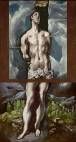
In his final years, the painting of “El Griego” becomes increasingly ethereal, dematerialised and ascending. Bodies lengthen, brushwork vibrates, and the laws of nature bend towards a transfigured reality. The foundation remains the Byzantine icon, enriched by Venetian and Roman Mannerism. The result is perhaps the most modern art of the early modern age.

Saint Sebastian

Doménikos Theotokópoulos

1610–14 · oil on canvas, 201.5 × 111.5 cm

Museo Nacional del Prado, Madrid

Look closer

A personal museum

El Greco dies in Toledo in April 1614. The inventory of the roughly twenty rooms of the palace rented from the Marquis of Villena is astonishing: almost fifty clay, wax and plaster figurines, two hundred prints, around 130 books and 143 paintings of his own, including finished works, models and sketches. The largest personal museum ever assembled by an artist, and inevitably ephemeral.

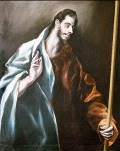
Saint Thomas

Doménikos Theotokópoulos

1610–14 · oil on canvas, 97 × 77 cm

Museo del Greco, Toledo

Look closer

Modern echoes

El Greco in dialogue with modern and contemporary art.

An ancestor of the Expressionists

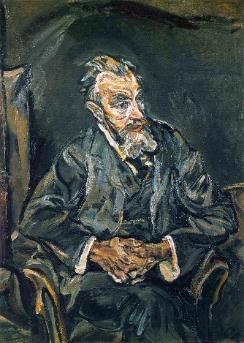
At the beginning of the twentieth century, El Greco’s vision finds its heirs in German and French Expressionism before the First World War. Elongated bodies, charged colours, figures that seem to burn from within. These years also mark the beginning of the art historians’ odyssey: rediscovered documents, attributed works, an oeuvre reconstructed painting by painting, and the first major international exhibitions.

Carl Moll

Oskar Kokoschka (1886–1980)

1913 · oil on canvas, 128 × 95 cm

Belvedere, Vienna

Look closer

Two skulls after El Greco

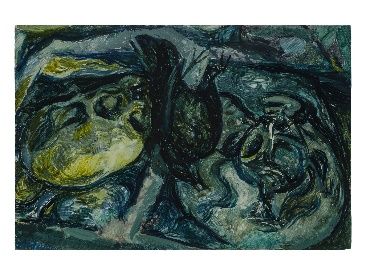
Four centuries after his death, El Greco remains a living interlocutor. Victor Man, one of the most acclaimed Romanian painters of our time, dedicates variations in oil and watercolour to him: “Two Skulls after El Greco and Blackbird”. His dark palette, forms dissolving into shadow and the almost liturgical mystery of his painting continue a dialogue that began in Toledo.

Two Skulls after El Greco and Blackbird

Victor Man (b. 1974)

2017 · oil on canvas mounted on wood, 30 × 41 cm

Collection of the artist

Look closer

Artworks in the exhibition

Audio guide

The audio guide will be added here when the recording is available.

Plan your visit

Continue your journey in the galleries of the National Museum of Art of Romania, in the former Royal Palace on Calea Victoriei.

MNAR tickets

The dates and admission arrangements for the El Greco exhibition are yet to be confirmed.

National Museum of Art of Romania
49–53 Calea Victoriei, Bucharest

View on the map

General MNAR opening hours

Wednesday — Friday
10:00 — 18:00
Saturday — Sunday
11:00 — 19:00
Monday — Tuesday
Closed

Ticket offices close one hour before the museum. Opening hours may change on public holidays.

Check current opening hours

Artwork details

Preview-resolution image. A high-resolution version will be added later.

Zoom with + / −, the wheel or two fingers. Drag to explore. Esc closes the viewer.

100%

Move the pointer or tap the image to show controls.